
The Campaign
Learning Machine

Overview
Liberu is not a software company. It’s an end-to-end influencer marketing agency, handling everything from creator sourcing to performance reporting. The platform was never the product. It was the competitive advantage. My job was to design a system that made Liberu faster and smarter than any agency running on spreadsheets and WhatsApp, so the business could scale without scaling
Client:
Liberu
Year:
2024 - 2025
Category:
Product design
/
Systems Thinking
Location:
Mexico City


✦ My Role
I led this project end to end: I diagnosed the problem, defined the product strategy and system architecture, and designed the core flows. I also directed a second designer on the talent and payments modules, setting the patterns and reviewing the work weekly.
✦ The Challenge
The operations team was managing dozens of creators per client across disconnected tools. The cost was clear:
Campaign reports took up to 2 weeks to produce manually
Project managers spent more time coordinating on WhatsApp than managing campaigns
Learnings were never captured, so every campaign started from zero
There was no way to know if a campaign was on track until it was over
Growing the business meant hiring more people
The deeper problem was structural: there was no single source of truth, and no way to turn performance data into institutional knowledge.
✦ My Approach
Before designing anything, I mapped how campaigns actually ran, not how they were supposed to run. I interviewed the operations team, observed their workflows, and audited every tool they used.
What I found was a process that existed informally but had never been systematized. People applied learnings from past campaigns, but only if they happened to remember them. Reports were pieced together by hand from scattered data. Content approvals depended on whoever was online on WhatsApp. And behind all of it, contracts and payments were chased one by one, over email and in spreadsheets.
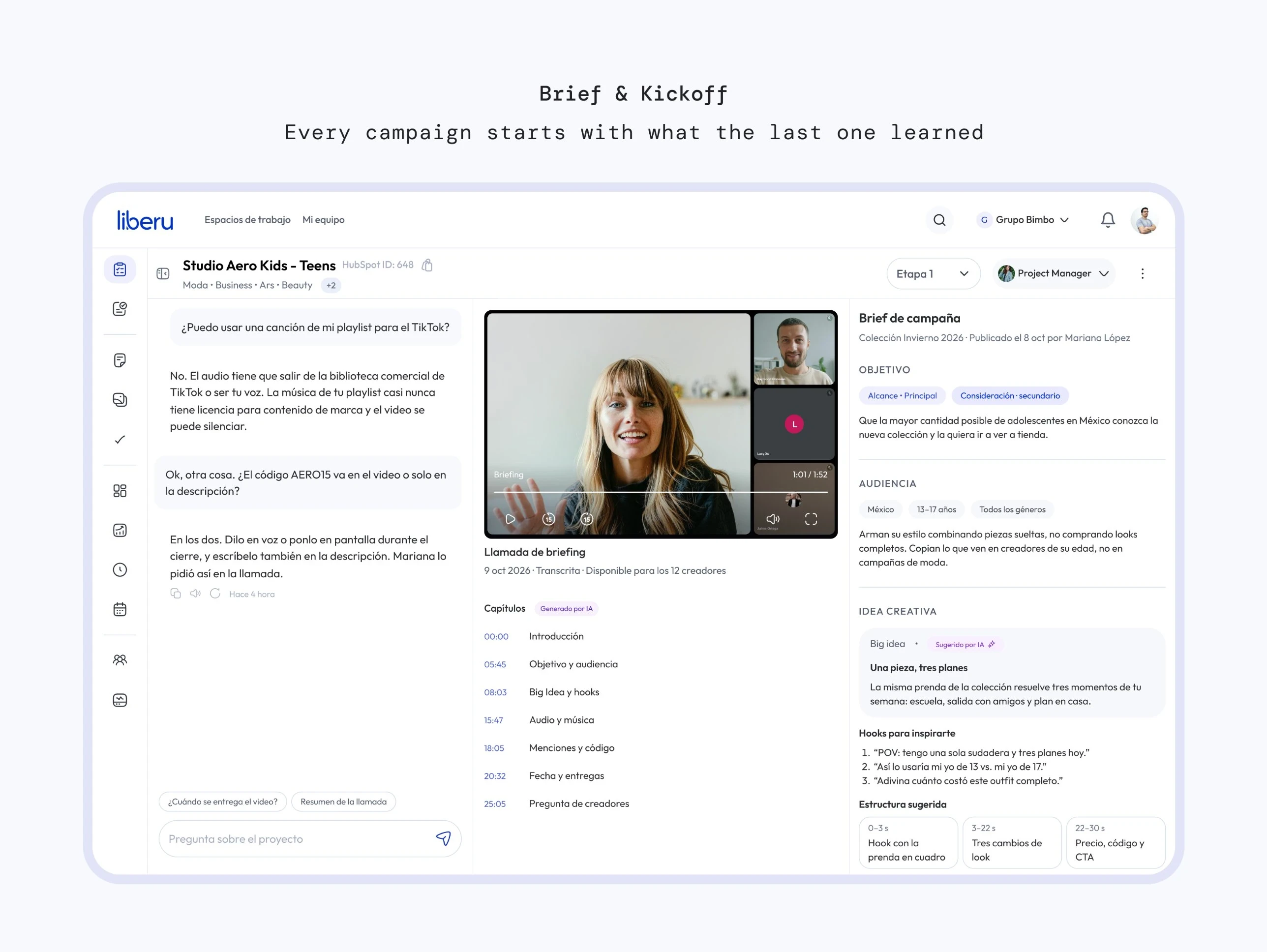
I formalized this into the Creative Learning Model: a continuous loop of eight stages, from brief to published content to performance analysis to reusable insights. The model didn’t invent new behavior. It made existing good behavior reliable and scalable.

The answer was Studio: a single operational layer where every stage of the loop lives. From the first brief to the final report, everything happens in one place, and the PM, the creator, and the client all work on the same campaign, each seeing their own layer.
AI is what closes the loop. Reports that used to take up to two weeks now take one hour: AI analyzes every piece of content and its comments, so the PM edits instead of writing from scratch. But speed isn’t the point. The findings from each report feed the next brief, where AI suggests the big idea and hooks based on what worked before. No campaign starts from zero again.
For the loop to work at scale, I also had to solve everything around it. Each creator’s contracts, documents, and payments now live inside the campaign, so a PM can manage more talent without getting buried in admin work.



The Result
Systematizing the campaign workflow didn't just improve the product — it changed how the business could scale. Less manual work, fewer dependencies on individual memory, and a platform that gets smarter with every campaign.

